The Cost of Silence: Why Client Portals are the Underrated Key to Agency Retention
In professional services, client retention has a big effect on agency unit economics. Research popularised by Bain's Frederick Reichheld (the inventor of NPS), covered by Harvard Business Review, is widely cited: a 5% improvement in retention can raise profits by 25% to 95%. That range isn't universal (the 25% came from financial services, the 95% from one bank's branch network), but it's still strong evidence that retention has outsized leverage on profit. Something agency owners and account managers talk about often, without much hard data behind it, is that agencies lose clients over a communication gap rather than delivery quality.

Written by Artur BurkaloFor over a decade, Artur has worked with agencies, run his own agency, and developed WordPress themes and plugins, including Destiny Elements.
Posted 3 July 2026
The Black Box problem in agency-client relations
When a client hires an agency, they are purchasing peace of mind. However, once the initial onboarding concludes, the relationship often enters a quiet period. Work is happening behind the scenes, but to the client, the agency is a "black box" where they deposit a retainer every month and receive only silence in return.
There isn't one definitive, precisely-sourced ranking of why B2B clients leave their agencies, but poor communication and a lack of visibility into work come up constantly in agency-side commentary and account management circles as a recurring theme, even when the underlying delivery is good. Traditional monthly email reports don't fully solve this; they are slow, often arrive late, and lack context.
McKinsey's self-service rule of thirds
Modern clients do not want to wait for a weekly sync meeting or call an account manager just to check on a website's uptime or view an audit report. They expect immediate access.
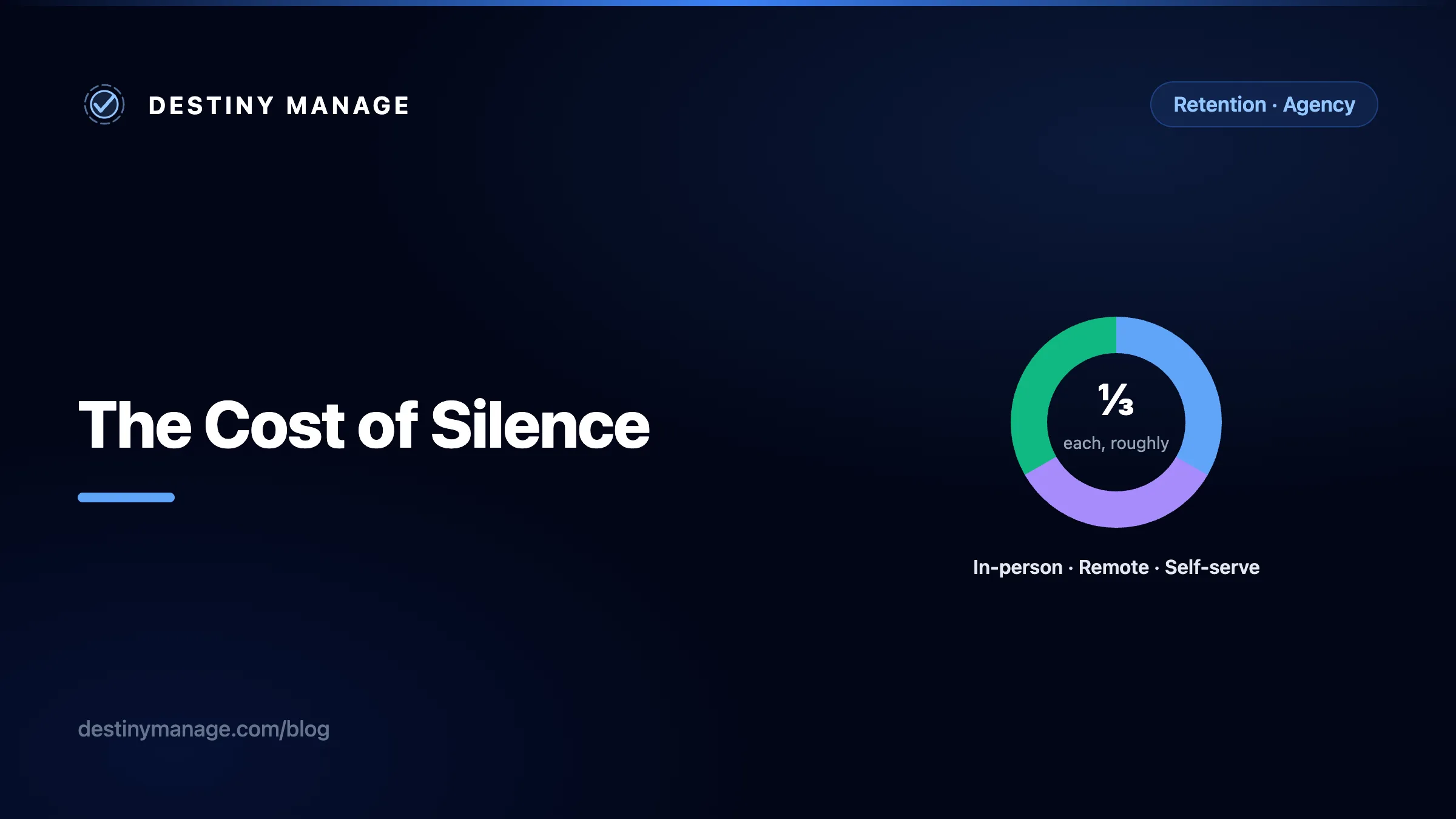
Research from McKinsey's B2B Pulse survey describes a "rule of thirds" in B2B buyer behaviour: at any given stage of the buying journey, roughly one-third of decision-makers prefer in-person interaction, one-third prefer remote human contact, and one-third prefer digital self-serve, and McKinsey reports this split holds fairly consistently across industries, geographies, and deal sizes.
A pattern reported in McKinsey's B2B Pulse research, not a fixed law of buyer behaviour.
The takeaway isn't that every client wants a portal instead of a person; it's that ignoring any one of the three legs, especially self-service, leaves a real share of your clients underserved. A dedicated client portal covers the self-serve third, letting stakeholders check project health on their own schedule without waiting on a meeting.
Anatomy of a high-retention client portal
An effective client portal should not be a static folder of shared PDFs. To drive retention, it must function as a dynamic dashboard of value. Key components include:
- 1. Continuous Uptime & Performance Logs
Displaying real-time server health and Core Web Vitals shows clients that their digital infrastructure is continuously monitored and secure under your watch.
- 2. Actionable Accessibility & SEO Auditing
Clients can review recent WCAG accessibility checks and search engine optimisation parameters, proving the value of your optimisation retainers.
- 3. Integrations with Developer Tickets
Instead of simple checklists, link findings to active tickets in Jira, GitHub, or Linear. This gives clients clear visibility into what is actively in the developer backlog.
The trust multiplier of premium white-labelling
Brand consistency builds professional authority. If you send clients to a generic third-party URL to view their metrics, the relationship feels fragmented.
By hosting the portal on a custom domain (e.g., portal.youragency.com) with your own logo and brand colours, you create a cohesive product experience. The client associates the dashboard directly with your agency rather than a generic third-party tool. That could plausibly deepen brand loyalty and raise switching costs, but that's our own read on the incentives at play, not a number from a specific study.
The efficiency case for client portals
Transparency doesn't just help with retention; giving clients 24/7 self-service access to their status reports, invoices, and audit logs likely reduces day-to-day service overhead too, since it removes work that would otherwise fall on your account managers:
- Account managers spend less time compiling manual reports and chasing email threads.
- Fewer ad-hoc "what's the status of issue X?" messages land in your inbox, since the answer is one click away.
- Onboarding new stakeholders at the client company is simplified since the history is preserved in one place.
We don't have a rigorously sourced figure for exactly how much overhead this removes, and it will vary a lot by agency and client mix, so treat the above as a directional pattern rather than a benchmark to hold yourself to.
None of this replaces good delivery. A portal doesn't fix a client relationship where the work itself, communication cadence, pricing, or results are the real problem, but for agencies that are already doing good work, it removes one common reason clients quietly disengage: not being able to see the work.
Related guides
Build premium white-labelled portals for your clients
Get started with Destiny Manage today
Destiny Manage lets you set up fully white-labelled agency portals under your own custom domain, complete with automated uptime monitoring, WCAG auditing, and developer ticket tracking.
Start free